差速轮运动学模型
机器人坐标系下的变换
运动特性为两轮差速驱动,其底部后方两个同构驱动轮的转动为其提供动力,前方的随动轮起支撑作用并不推动其运动,如下图两轮差速驱动示意图所示。
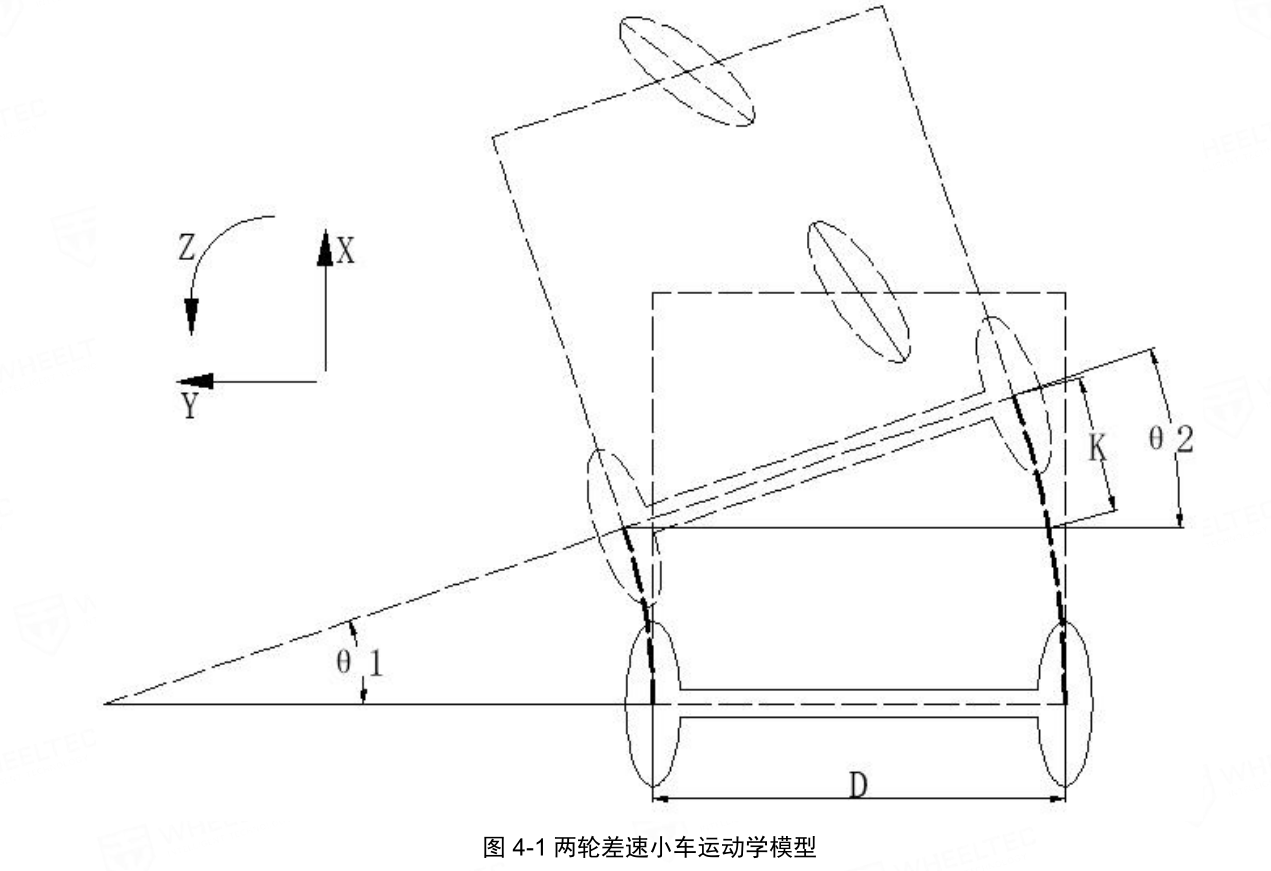
机器人的运动简化模型如图 4-1 所示,X 轴正方向为前进、Y 轴正方向为左平移、Z 轴正方向为逆时针。机器人两个轮子之间的间距为 D,机器人 X 轴和 Z 轴的速度分别为:Vx和Vz ,机器人左轮和右轮的速度分别为:Vl 和Vr。
假设机器人往一个左前的方向行进了一段距离,设机器人的右轮比左轮多走的距离近似为 K, 以机器人的轮子上的点作为参考点做延长参考线,可得:θ1=θ2 。由于这个Δt 很小,因此角度的变化量θ1 也很小,因此有近似公式:
θ2≈sin(θ2)=DK
由数学分析可以得到下面的式子:
\begin{equation}
\mathrm{K}=\left(\mathrm{V}_{\mathrm{R}}-\mathrm{V}_{\mathrm{L}}\right) * \Delta \mathrm{t}, \quad \omega=\frac{\theta_{1}}{\Delta \mathrm{t}}
\end{equation}
由上面的公式和式子可以求解出运动学正解的结果:机器人 X 轴方向速度
Vx=(Vl+Vr)/2
机器人 Z 轴方向速度:
Vz=(Vr−Vl)/D
由正解直接反推得出运动学逆解的结果:
机器人左轮的速度:
Vl=Vx−(Vz∗D)/2
机器人右轮的速度:
Vr=Vx+(Vz∗D)/2
实现
运动学正解
1
2
3
4
5
6
7
8
9
10
11
12
13
14
15
16
|
Eigen::Vector3f MotorToRobotSpeed(void)
{
Eigen::Vector3f robot_speed;
robot_speed(0) = -0.5f * motor_line_speed_measure_(0) + 0.5f * motor_line_speed_measure_(1);
robot_speed(1) = 0 * motor_line_speed_measure_(0) + 0 * motor_line_speed_measure_(1);
robot_speed(2) = (0.5f / body_radius_) * (motor_line_speed_measure_(0) + motor_line_speed_measure_(1));
return robot_speed;
}
|
运动学逆解
1
2
3
4
5
6
7
8
9
10
11
12
13
14
15
16
17
|
void RobotToMotorSpeed(Eigen::Vector3f& robot_speed)
{
motor_line_speed_target_(0) = -1 * robot_speed(0) + 0 * robot_speed(1) + body_radius_ * robot_speed(2);
motor_line_speed_target_(1) = 1 * robot_speed(0) + 0 * robot_speed(1) + body_radius_ * robot_speed(2);
if(motor_num_ >= 4) {
motor_line_speed_target_(2) = motor_line_speed_target_(0);
motor_line_speed_target_(3) = motor_line_speed_target_(1);
}
}
|
坐标系旋转
全局坐标系到机器人坐标系的变换
一个平面坐标系逆时针旋转一个角度后得到另一个坐标系,则同一个点在这两个坐标系之间的几何关系如下:
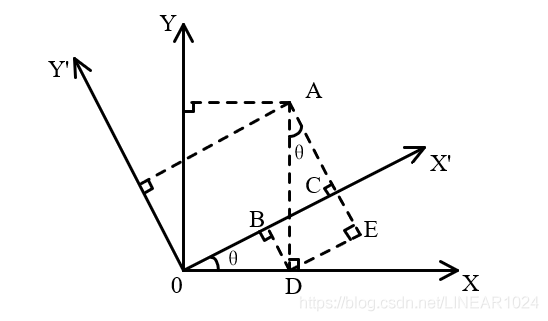
由上图可得:
\begin{equation}
\begin{aligned}
x^{\prime} &=O B+B C \\
&=O D \cos \theta+A D \sin \theta \\
&=x \cos \theta+y \sin \theta
\end{aligned}
\end{equation}
\begin{equation}
\begin{aligned}
y^{\prime} &=A E-C E \\
&=A D \cos \theta-O D \sin \theta \\
&=y \cos \theta-x \sin \theta
\end{aligned}
\end{equation}
则反过来的关系如下:
\begin{equation}
\left[\begin{array}{l}
x \\
y
\end{array}\right]=\left[\begin{array}{cc}
\cos \theta & -\sin \theta \\
\sin \theta & \cos \theta
\end{array}\right]\left[\begin{array}{l}
x^{\prime} \\
y^{\prime}
\end{array}\right]
\end{equation}
则反过来的关系如下:
\begin{equation}
\left[\begin{array}{l}
x \\
y
\end{array}\right]=\left[\begin{array}{cc}
\cos \theta & -\sin \theta \\
\sin \theta & \cos \theta
\end{array}\right]\left[\begin{array}{l}
x^{\prime} \\
y^{\prime}
\end{array}\right]
\end{equation}
实现
正解
1
2
3
4
5
6
7
8
9
10
11
12
13
14
15
16
17
|
Eigen::Vector3f GlobalToRobotSpeed(Eigen::Vector3f& global_speed)
{
Eigen::Vector3f robot_speed;
Eigen::Matrix3f rotate_mat;
rotate_mat << cos(global_coordinat_z_), sin(global_coordinat_z_), 0.0f,
-sin(global_coordinat_z_), cos(global_coordinat_z_), 0.0f,
0.0f, 0.0f, 1.0f;
robot_speed = rotate_mat * global_speed;
return robot_speed;
}
|
逆解
1
2
3
4
5
6
7
8
9
10
11
12
13
14
15
16
17
|
Eigen::Vector3f RobotToGlobalSpeed(Eigen::Vector3f& robot_speed)
{
Eigen::Vector3f global_speed;
Eigen::Matrix3f rotate_mat;
rotate_mat << cos(global_coordinat_z_), -sin(global_coordinat_z_), 0.0f,
sin(global_coordinat_z_), cos(global_coordinat_z_), 0.0f,
0.0f, 0.0f, 1.0f;
global_speed = rotate_mat * robot_speed;
return global_speed;
}
|
参考文献
https://www.guyuehome.com/33953
https://blog.csdn.net/LINEAR1024/article/details/104956774
https://www.guyuehome.com/8392
[[focPrinciple]]
[[FOCCurrentSampling]]
[[focRelatedAlgorithms]]
[[imuCalibration]]
[[imuAttitudeCalculation]]
[[odriverSVM]]
[[odriverSpeed]]